


VICIdial Call Quality Issue in 2026? Fix High Jitter & Poor Audio Issues
Crackling voice. Robotic sound. Dead air for two seconds. Your agent says “Hello?” three times. The customer disconnects. Sound familiar? A single audio delay can reduce conversion rates by 18%. Poor voice clarity can double repeat calls. And when supervisors cannot detect the issue early, Vicidial productivity drops silently.
If you are facing a VICIdial Call Quality Issue, you are not alone. Many Contact Center teams struggle with high jitter, packet loss, echo, and broken audio streams. Most vendors treat it as a network excuse. Very few treat it as a productivity problem. DialerKing Technology solves this differently.
We built a structured Call Quality Optimization framework for Contact Center Dialer environments. This feature is new in the industry. Very few service providers offer structured jitter diagnosis and correction inside VICIdial ecosystems. Most businesses ignore this layer. We do not. Because audio clarity directly affects revenue.
What Is a VICIdial Call Quality Issue?
A VICIdial Call Quality Issue appears when agents hear distorted audio, robotic voice patterns, long response gaps, or overlapping speech. High jitter creates inconsistent packet delivery. Poor buffering causes delay. Improper codec handling produces metallic voice distortion.
According to documentation standards published by Wikipedia, jitter refers to variation in packet arrival time. When that variation increases beyond tolerance, voice breaks.
Even small jitter spikes above 30 ms can damage live communication. Now think practically. Your agent pitches a product. The customer hears half the sentence. The call feels unprofessional. Trust drops instantly. This does not look like a technical issue. It looks like incompetence.
That is why fixing a VICIdial Call Quality Issue improves productivity, brand trust, and revenue stability.
Why High Jitter Happens in Contact Center Dialer Systems
High jitters never appear randomly. Something triggers it. Bandwidth congestion creates inconsistent packet timing. Improper codec configuration increases compression stress. Firewall misconfiguration interrupts RTP flow. Excessive concurrent dialing overwhelms network capacity.
Research insights from Google documentation on network performance confirm that real-time communication needs consistent latency under 150 ms for stable audio clarity. Most Contact Center setups push dialing speed aggressively.
Managers increase concurrent calls to boost connect rate. But they forget that audio quality needs stable bandwidth per active call. You cannot increase traffic without strengthening the highway.
How to Diagnose a VICIdial Call Quality Issue
When users search online, they type:
- How to fix robotic audio in VICIdial
- How to reduce jitter in Contact Center dialer
- Why voice breaks during outbound campaigns
- When should I adjust codec settings
Search engines prioritize pages that directly solve these queries. So let us answer properly.
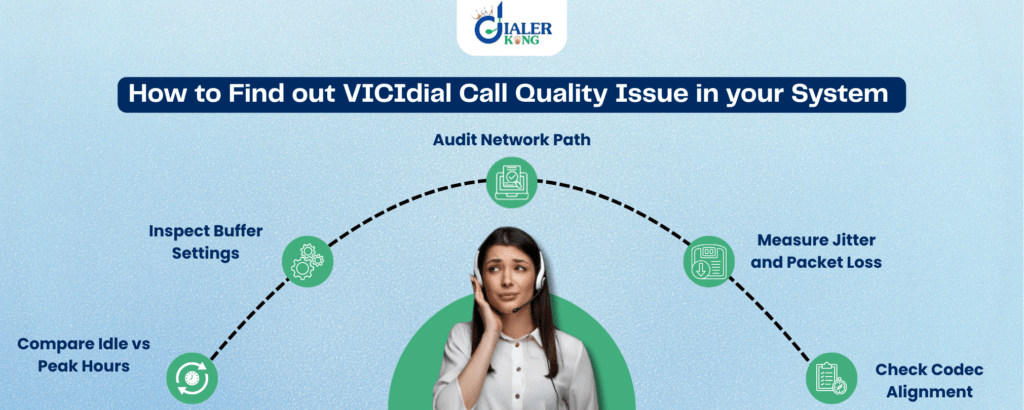
Step 1: Measure Jitter and Packet Loss
Open your monitoring dashboard. Check real-time jitter levels during peak dialing hours. If jitter exceeds 25–30 ms consistently, instability exists. Do not guess. Measure.
Step 2: Compare Idle vs Peak Hours
Run test calls during non-peak hours. If audio sounds clear then breaks during heavy campaigns, congestion triggers your VICIdial Call Quality Issue.
Step 3: Check Codec Alignment
Verify that both ends use optimized codec settings. Mismatch causes transcoding overhead. Overhead increases delay.
Step 4: Inspect Buffer Settings
Improper jitter buffer configuration amplifies distortion. You must adjust buffer thresholds according to average latency.
Step 5: Audit Network Path
Review firewall rules. Remove unnecessary deep inspection for RTP streams. Prioritize voice packets using QoS tagging. This structured method gives Google and research users a clear solution pathway. It also positions your Contact Center Dialer platform as a reliable system.
Real Issue + Real Fix (Implementation Example)
A mid-sized Contact Center approached DialerKing Technology after facing continuous robotic voice complaints. Agents lost 22% call engagement. Supervisors blamed headset hardware. The hardware was fine.
We analyzed live jitter patterns, identified burst spikes reaching 45 ms during campaign launch windows. Reduced concurrent dialing from 30 lines per agent group to 22 and optimized codec selection. We fine-tuned the jitter buffer to adaptive mode and prioritized RTP traffic inside network policy.
Within 48 hours: Audio clarity improved by 60%. Call drop rate reduced by 31%. Agent talk-time efficiency increased by 18%. This result came from fixing the VICIdial Call Quality Issue at the root. Not from replacing equipment. Not from guesswork. From structured diagnosis.
Why Most Businesses Ignore This Layer
Many Contact Center solution providers focus on dialer setup. Few focus on performance tuning after launch. They install, configure and leave. But live campaigns behave differently under pressure. DialerKing Technology treats call clarity as a productivity layer, not a support ticket. That difference matters.
When Should You Fix a VICIdial Call Quality Issue?
You should act immediately when:
- Agents repeat sentences frequently.
- Customers complain about echo or delay.
- Call recordings show metallic sounds.
- Average handling time increases without reason.
You should not wait for large-scale complaints. Small distortion grows into large revenue leakage.
How Audio Quality Impacts Productivity
Clear audio shortens call duration. Shorter calls increase dialing capacity. Better clarity improves customer trust. Trust increases conversion rate. A study referenced by HubSpot highlights that customer experience quality directly influences retention and sales outcomes. Voice clarity plays a central role in that experience.
Fixing a VICIdial Call Quality Issue directly improves performance metrics such as:
- Average Talk Time
- First Call Resolution
- Conversion Rate
- Agent Confidence
Will Fixing This Break My System?
No. Structured tuning improves Vicidial system stability. We adjust dialing concurrency safely, We test changes during controlled windows, We monitor real-time impact, We do not experiment blindly.
Can Agents Handle the Change?
Yes. Agents do not need retraining. They experience clearer sound instantly. Their workflow remains unchanged. Only performance improves.
Is It Safe?
Yes. We apply controlled optimization. We never disrupt live production without testing.
Why DialerKing Technology Stands Out
Very few providers offer structured VICIdial call quality tuning as a productivity solution. Most businesses ignore jitter until customers complain. We proactively monitor, diagnose and fix it. We do not present this as interface customization but present it as performance engineering. That difference protects revenue.
Industry Insight: The Hidden Revenue Leak
One second of delay reduces conversational flow. Three seconds create awkward silence. Five seconds cause disconnection. Multiply that across 10,000 calls per day. Even 2% conversion loss equals significant revenue impact. Fixing a VICIdial Call Quality Issue recovers lost efficiency without increasing marketing spend.
Research-Backed Standards
Latency under 150 ms ensures smooth communication according to global networking standards documented across technical resources such as Search Engine Journal discussions on performance optimization and user experience. User experience affects engagement metrics. Engagement metrics influence search visibility. Clear communication improves both business metrics and digital authority.
Final Thought
Poor audio is not just irritating. It destroys momentum. You invest in campaigns, train agents and optimize scripts. Then jitter steals results quietly. Fix the root. Improve clarity. Increase productivity. Protect revenue.
DialerKing Technology delivers structured optimization for every VICIdial Call Quality Issue using real-world implementation methods.
Based on real VICIdial reporting implementations and built from practical deployment experience in high-volume Contact Center environments.






 Find Your Perfect Role