
- What Is VICIdial Disposition?
- What Is the VICIdial System?
- How VICIdial Disposition Works Technically
- How Disposition Affects Lead Recycling
- Standard VICIdial Disposition Codes Explained
- VICIdial Disposition on ViciBox
- Custom VICIdial Disposition Development
- VICIdial Disposition Reporting and Analytics
- Why VICIdial Disposition Setup Matters for Operations
- FAQs:
- DialerKing's VICIdial Development Expertise
In VICIdial, every one of those outcomes gets recorded through a mechanism called a VICIdial disposition – a short code or label that tells the system exactly what happened on that call. Every outbound call ends with a result. Someone answered and converted. A voicemail was picked up. The number was disconnected. The contact asked to be called back next week.
For contact centers running VICIdial, dispositions are far more than bookkeeping. They drive what happens next: whether a lead gets recycled into the dialer, scheduled for a callback, removed from the campaign, or flagged for a supervisor. Getting your VICIdial disposition setup right is one of the most operationally important decisions you’ll make.
This guide covers how VICIdial disposition works, what the standard statuses mean, how they interact with dialing behavior, and how DialerKing helps contact centers build custom disposition logic that fits their exact workflows.
What Is VICIdial Disposition?
A VICIdial disposition is a label that an agent (or the system itself) assigns to a call after it ends. It answers a simple question: what was the result of this call?
Dispositions in VICIdial serve several purposes at once. They classify the outcome for reporting and analytics, They determine how the lead record is treated going forward -whether it gets dialed again, when, and how many times, They also feed into campaign-level statistics that supervisors use to measure penetration rates, agent productivity, and conversion performance.
What Does Call Disposition Mean in Practice?
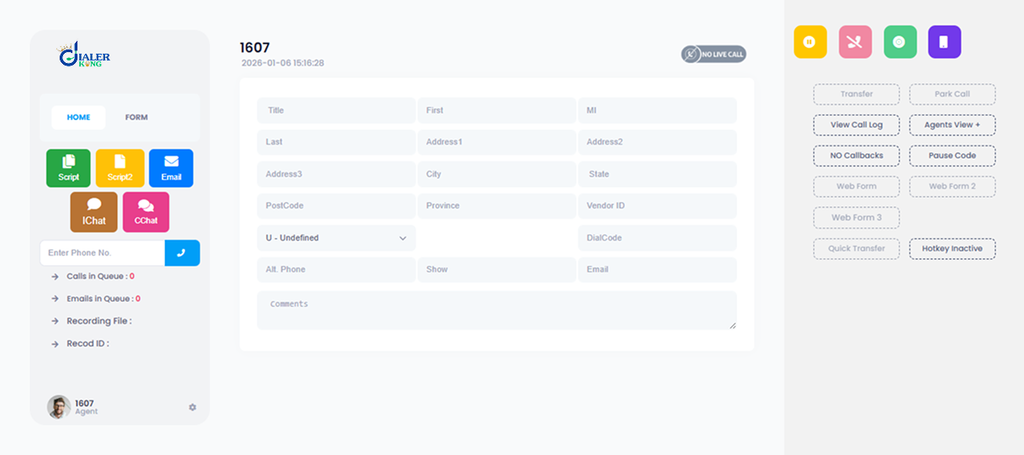
Call disposition, in its simplest form, is the final status a call receives. In a VICIdial environment, this happens at the agent level: after the conversation ends, the agent selects a disposition from a dropdown menu before moving on to the next call. The system logs that selection against the lead record, timestamps it, and -depending on how the disposition is configured -triggers specific follow-up actions.
Some dispositions are set by agents manually. Others are set automatically by the system when a call never reaches a live agent at all -for example, when a number is busy, unanswered, or disconnected before the predictive dialer even transfers the call.
What Is the VICIdial System?
Before going deeper into disposition logic, it helps to understand the platform itself.
VICIdial is an open-source contact center suite built on top of Asterisk, the widely-used open-source telephony framework. It provides outbound predictive dialing, inbound queue management, agent scripting, real-time monitoring, and a full suite of reporting tools -all without the licensing costs of proprietary platforms.
Who Uses VICIdial?
VICIdial is used across a broad range of industries and operation types:
- BPOs and outsourced contact centers running high-volume outbound campaigns
- Lead generation companies working with purchased or self-generated contact lists
- Appointment-setting agencies managing callback schedules across multiple campaigns
- Customer support teams handling inbound queues alongside outbound follow-up
- Enterprise communication environments that need scalable, customizable telephony infrastructure
Its open-source nature makes it particularly popular with organizations that want full control over their dialing platform -the ability to customize interfaces, build integrations, modify logic, and scale without per-seat licensing.
How VICIdial Disposition Works Technically
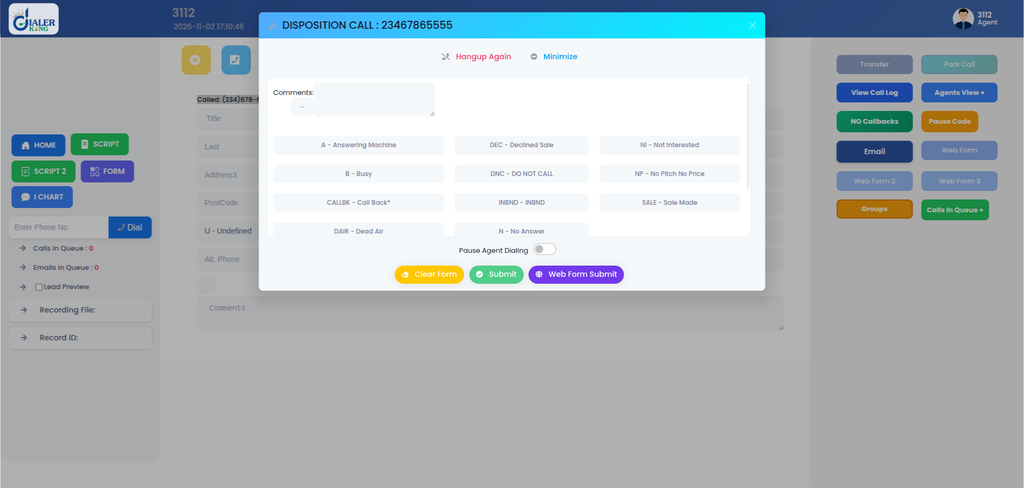
When a call ends in VICIdial, the agent is presented with a disposition screen. This screen displays a list of disposition codes that have been configured for the campaign. The agent selects the appropriate one, optionally adds a note, and submits. The record is then updated in the VICIdial database.
System-Level vs. Agent-Level Dispositions
Not all dispositions in VICIdial are chosen by agents. The system also assigns dispositions automatically based on the outcome of the dialing attempt itself.
System-assigned dispositions include codes like:
- A -Answering machine detected
- B -Busy signal
- N -No answer (ring, no pickup)
- DC -Disconnected number
- DROP -Call dropped before agent answer
These happen at the dialer level, before any agent interaction. They tell the system how to recycle the lead according to the campaign’s retry settings.
Agent-assigned dispositions are the outcomes that require a human judgment call -whether the prospect converted, requested a callback, asked to be removed, or needs a follow-up at a specific time.
How Disposition Affects Lead Recycling
One of the most important functions of a VICIdial disposition is controlling lead recycling. Each disposition code can be configured with specific behavior:
| Disposition Code | Typical Meaning | Lead Recycle Behavior |
|---|---|---|
| SALE / CONV | Converted, deal closed | Remove from active dialing |
| CB | Callback requested | Schedule for specific date/time |
| NI | Not interested | Remove or flag as DNC |
| NA / NAN | No answer | Recycle after N hours |
| BUSY | Line busy | Recycle after short interval |
| DC | Disconnected | Remove from campaign |
| VM | Voicemail left | Recycle after 24–48 hours |
| DNC | Do not call | Flag, never dial again |
| CALLBK | General callback | Reschedule based on agent input |
The recycling logic -how many times a lead gets retried, at what intervals, and under what conditions -is configured per campaign in VICIdial. Disposition codes are the mechanism that connects each call outcome to these recycling rules.
Standard VICIdial Disposition Codes Explained
VICIdial ships with a set of default disposition codes. Contact centers typically customize these to match their specific campaign needs, but understanding the defaults is a useful starting point.
Common Default Dispositions
SALE – The call resulted in a conversion or closed deal. In most campaign configurations, this disposition removes the lead from further dialing and triggers any post-sale workflow.
NI (Not Interested) – The contact explicitly declined. Depending on compliance requirements, this may trigger a DNC flag or simply pause dialing on that record.
CB (Callback) – The contact asked to be reached at a later time. VICIdial’s callback scheduler allows agents to set a specific date and time, and the system will route the call back to that agent or to the general queue.
NA (No Answer) – The line rang but no one picked up. VICIdial will typically retry this lead after a configured interval.
BUSY – The line was busy. Short retry intervals are common for this disposition.
DC (Disconnected) – The number is no longer in service. These leads are typically removed from the active campaign.
DNC (Do Not Call) – The contact has requested no further contact. This disposition should trigger a compliance flag across all campaigns.
VM (Voicemail) – The call reached a voicemail system. Agents may leave a message or simply log the outcome for a later retry.
DROP – A system-assigned code for calls dropped by the predictive dialer before reaching an agent. High DROP rates are a signal that dialing ratios need adjustment.
VICIdial Disposition on ViciBox
ViciBox is a prepackaged VICIdial installation that bundles VICIdial, Asterisk, and the underlying OS into a single deployable image. Disposition behavior on ViciBox works identically to a standard VICIdial installation – the same campaign-level configuration, the same agent interface, the same database structure.
The distinction is in deployment: ViciBox makes it faster to stand up a working VICIdial environment. The disposition logic itself, however, is entirely standard VICIdial and can be customized the same way.
Custom VICIdial Disposition Development
Default disposition codes cover the basics, but many contact centers need disposition structures that go considerably further. A lead generation company running multiple verticals needs different disposition sets for each campaign. An appointment-setting operation needs disposition codes that trigger calendar integrations. A compliance-heavy environment needs dispositions that automatically enforce DNC rules and generate audit logs.
This is where custom VICIdial disposition development becomes essential.
What DialerKing Builds
At DialerKing, we develop fully customized disposition frameworks as part of our broader VICIdial development services. This includes:
Custom disposition code sets tailored to specific campaign types, industries, and compliance requirements. Rather than adapting your workflow to a generic list, your agents work with a disposition menu that reflects exactly how your operation classifies outcomes.
Disposition-triggered lead recycling logic that goes beyond VICIdial’s standard retry settings. We build custom recycling rules that account for time zones, contact history, attempt counts, campaign priority, and agent-specific callbacks.
CRM-connected disposition workflows where selecting a disposition in VICIdial automatically pushes data to your CRM. A SALE disposition can create a deal record in Salesforce or HubSpot. A CB disposition can create a follow-up task. A DNC disposition can update contact preferences across your entire CRM database – without manual data entry.
Compliance-aware disposition logic for operations that need to document contact attempts, honor opt-out requests, and maintain records for regulatory review. We build disposition structures that feed directly into compliance reporting.
Custom agent disposition interfaces built with modern React-based frontends and Tailwind CSS. Instead of VICIdial’s default disposition dropdown, agents can work with purpose-built screens that guide them through outcome selection, collect structured notes, and make the right disposition choice clear and fast.
VICIdial Disposition Reporting and Analytics
Disposition data is only valuable if it’s being analyzed. VICIdial includes basic disposition reporting, but high-performance operations typically need reporting that goes further.
What Standard VICIdial Disposition Reports Show
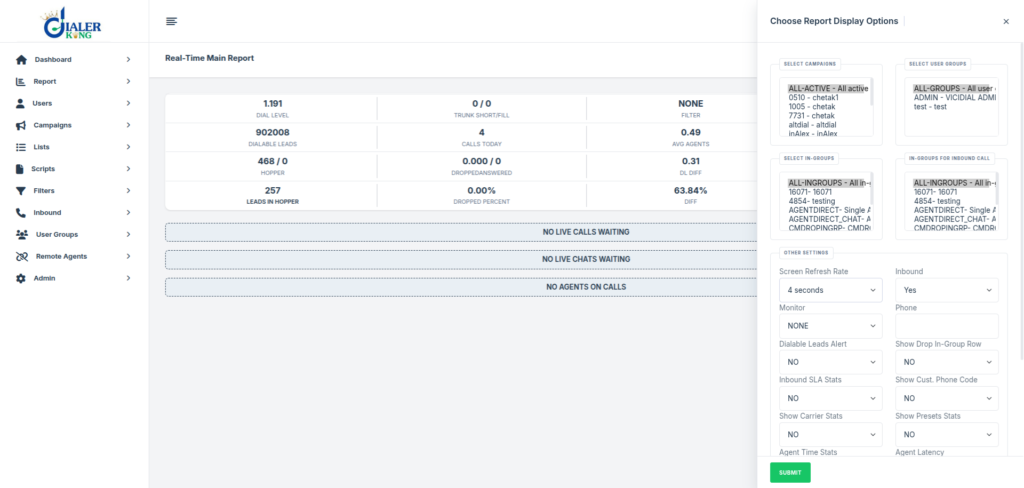
VICIdial’s built-in reports can show disposition counts per campaign, per agent, and per time period. You can see how many calls ended in each outcome, filter by date range, and export raw data.
What Advanced Disposition Reporting Adds
DialerKing builds custom reporting layers on top of VICIdial that give supervisors and managers a much richer view of disposition data:
Conversion tracking by disposition path – understanding not just what the final disposition was, but what sequence of prior dispositions led to a conversion. This identifies which retry sequences produce results.
Agent-level disposition analysis – comparing disposition distributions across agents to identify coaching opportunities. An agent with an unusually high NI rate relative to their peers may need different objection-handling support.
Disposition-to-campaign performance correlation – linking disposition patterns to campaign-level outcomes like contact rate, conversion rate, and revenue per lead.
Real-time disposition dashboards – live views that supervisors can monitor during operating hours, showing current disposition rates across all active campaigns and flagging anomalies as they develop.
Why VICIdial Disposition Setup Matters for Operations
Poorly configured dispositions create compounding problems across an operation. Leads that should have been removed get redialed, wasting agent time. Leads that should be retried get flagged as DNC. Callback appointments get lost because the disposition didn’t trigger a scheduler. Conversion data is inaccurate because agents are selecting the wrong code.
A well-structured VICIdial disposition framework, by contrast, creates a tight feedback loop between call outcomes and dialing behavior. Every call result is captured accurately. Lead recycling happens on the right schedule. Compliance obligations are met automatically. And reporting reflects what’s actually happening in the operation.
Getting disposition right is foundational -it shapes everything downstream from campaign performance to compliance documentation to agent productivity metrics.
FAQs:
Q2. Can VICIdial disposition codes be customized❓
Yes, VICIdial allows fully custom disposition code sets per campaign. DialerKing builds tailored disposition frameworks that match your specific workflow, compliance needs, and CRM integration requirements.
Q3. What is the difference between system and agent dispositions in VICIdial❓
System dispositions are assigned automatically by the dialer for outcomes like busy, no answer, or disconnected – before any agent interaction. Agent dispositions are manually selected by the agent after a live conversation based on what actually happened on the call.
Q4. How does VICIdial disposition affect lead recycling❓
Each disposition code can be configured with specific recycling rules – how many times a lead is retried, at what intervals, and under what conditions. This ensures leads are worked efficiently without over-dialing or prematurely removing viable contacts.
Q5. Who uses VICIdial and why is disposition important for them❓
VICIdial is used by BPOs, lead generation companies, appointment-setting agencies, and enterprise communication teams who run high-volume outbound campaigns. For all of them, accurate disposition tracking is critical because it directly controls lead recycling, compliance, reporting accuracy, and overall campaign performance.
DialerKing’s VICIdial Development Expertise
DialerKing provides end-to-end VICIdial development services, from initial architecture and custom GUI development to CRM integrations, AGI scripting, AMI-based monitoring tools, and performance optimization for large-scale deployments.
Our work spans the full VICIdial stack – custom agent interfaces, supervisor dashboards, real-time monitoring panels, multi-server architecture, database optimization for high-concurrency environments, and custom reporting systems built beyond what standard VICIdial reports provide.
For organizations that need their VICIdial disposition framework rebuilt, extended, or integrated with external systems, DialerKing brings both the technical depth and the contact center operational knowledge to do that work correctly. We can design, develop, and deploy the solution your operation needs.